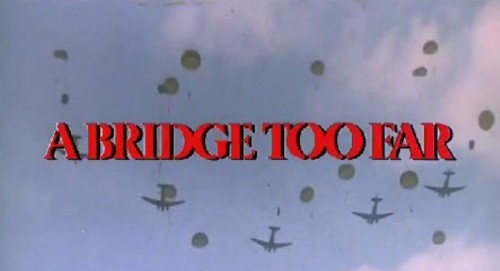
A Bridge Too Far, 1977. 'Out of the sky comes the screen's most incredible spectacle of men and war!'
After the Memorial Day weekend it seems appropriate to remember the troops of World War II with a look at A Bridge Too Far on this Trailer Tuesday.
Richard Attenborough’s A Bridge Too Far was released in June of 1977 and tells the true story of Operation Market Garden. A huge list of stars appear in this classic war film including; Michael Caine, Anthony Hopkins, Laurence Olivier, Sean Connery and Robert Redford. I caught this one on TV many times in the 70s (and beyond) and it was a childhood favorite.
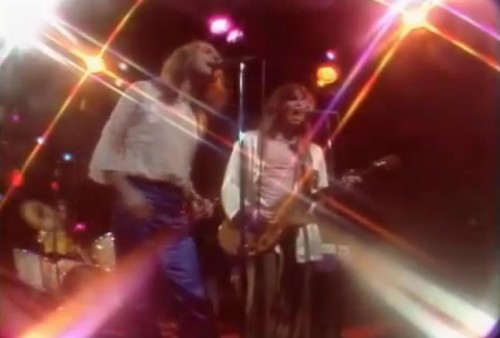
Stories had a #1 US hit in 1973 with a cover of Hot Chocolate’s “Brother Louie”.
Here’s the short-lived (’72-’74) NY-based band playing live on The Midnight Special (with an introduction from Jose Feliciano) in ’73. Have a great Memorial Day Monday.
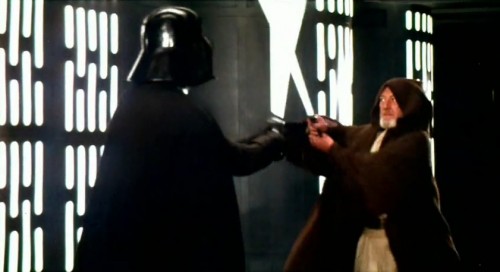
Today marks 35 years since the release of Star Wars on May 25th, 1977. In celebration, here’s a link to a Time Magazine article on the anniversary and the original, decades-old Star Wars trailer. Was it really that long ago that I sat in the theater watching this film for the first time – my 10-year-old mind well and truly blown away?
Time Quote:
“In May 1977, though, the choice of a PG-rated fantasy as the cover subject for the premier newsmagazine must have seemed a risk. The signature films of that super-serious movie decade had been anguished, acidulous exposés of an America torn apart by corruption in the police (Serpico), municipal politics (Chinatown) and the White House itself (All the President’s Men). Hollywood moguls were proud to be making grownup films for adult audiences — the same demographic as TIME’s readers. Who would care about a movie with light sabers and princesses in distress and chases that looked like those new things the kids loved, videogames?
Yet that first Star Wars story presciently sensed a shift in the cultural barometer: that moviegoers were tiring of urban cynicism and ready for an enthralling, childlike distraction. The movie, Clarke wrote, is ‘aimed at kids — the kid in everybody,’ and Lucas seconded that notion. ‘The word for this movie is fun,’ he said. ‘My main reason for making it was to give young people an honest, wholesome fantasy life, the kind my generation had. We had westerns, pirate movies, all kinds of great things. Now they have The Six Million Dollar Man and Kojak. Where are the romance, the adventure, and the fun that used to be in practically every movie made?’ In 2012, the icon status of Lee Majors and Telly Savalas has long since dimmed, while Luke Skywalker and Han Solo, and Darth Vader too, live in the minds of kids everywhere — the kids in everybody, for whom most movies of the past few decades have been made.”
Here’s the original 1977 Star Wars trailer. Take note of the white lightsabers and distinct lack of iconic music and Darth Vader’s voice.
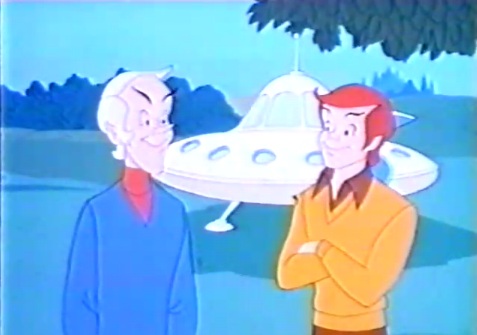
My Favorite Martians. 'You won't believe the things they do...'
Filmation’s My Favorite Martians, an animated show based on the 60s sitcom, first aired September-December, 1973. 16 episodes were produced and featured the characters Uncle Martin, Tim, Mrs. Brown, Detective Brennan, Katy, Andromeda and an alien pet named Okey.
Unfortunately, none of the actors from the live-action series provide voices but the great Jonathan Harris (from Lost in Space) provides the voice of Martin. Enjoy the intro and have a happy Funshine Friday!
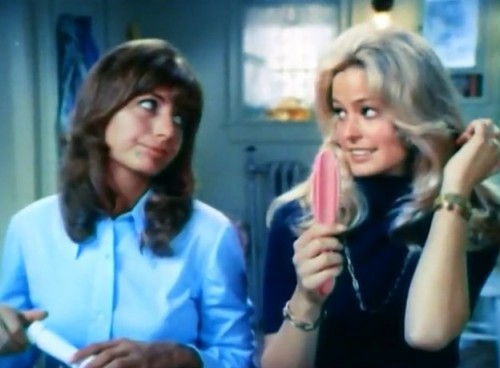
Head & Shoulders with Marshall & Fawcett, early 1970s. 'Hates your dandruff. Loves your hair.'
Commercial break time. Here’s one for Head & Shoulders shampoo from the early 1970s featuring two future TV series stars. Watch as wacky roommates Penny Marshall (Laverne & Shirley) and Farrah Fawcett (Charlie’s Angels) lather up the laughs in the bathroom.
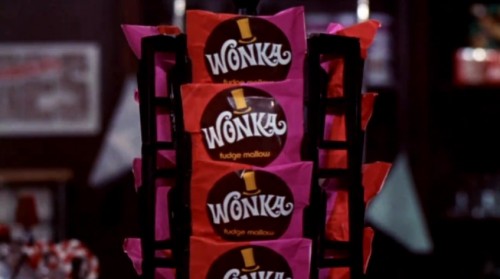
I’ve got a golden…wrapper! Jason Liebig over at CollectingCandy.com writes about and shows off recently-uncovered real life Wonka Bars which went into production after the release of the Willy Wonka & the Chocolate Factory film in 1971.
You may remember various types of Wonka-branded chocolates, such as Super Skrunch and Peanut Butter Oompas, but these are the famed “Wonka Bars” which only appeared for a brief time in the mid-70s. Hop over and indulge your sweet-tooth memories.
Collecting Candy Quote:
“The Wonka Bars of the mid-1970′s were a taffy type of confection, and they’re ones I remember enjoying, too. Based on what I’ve been able to research though, I don’t think they were around all that long.
In my years of collecting and talking with other folks about 1970′s Wonka, there aren’t that many people that even remember these. As for turning up wrappers from them, I’d never been able to find an image of one, let alone an actual example, until earlier this year. Finally, from out of the L.M. Kallok Confectionery Collection came not one, but four examples of 1970′s Wonka Bar wrappers – one representing each flavor released.”